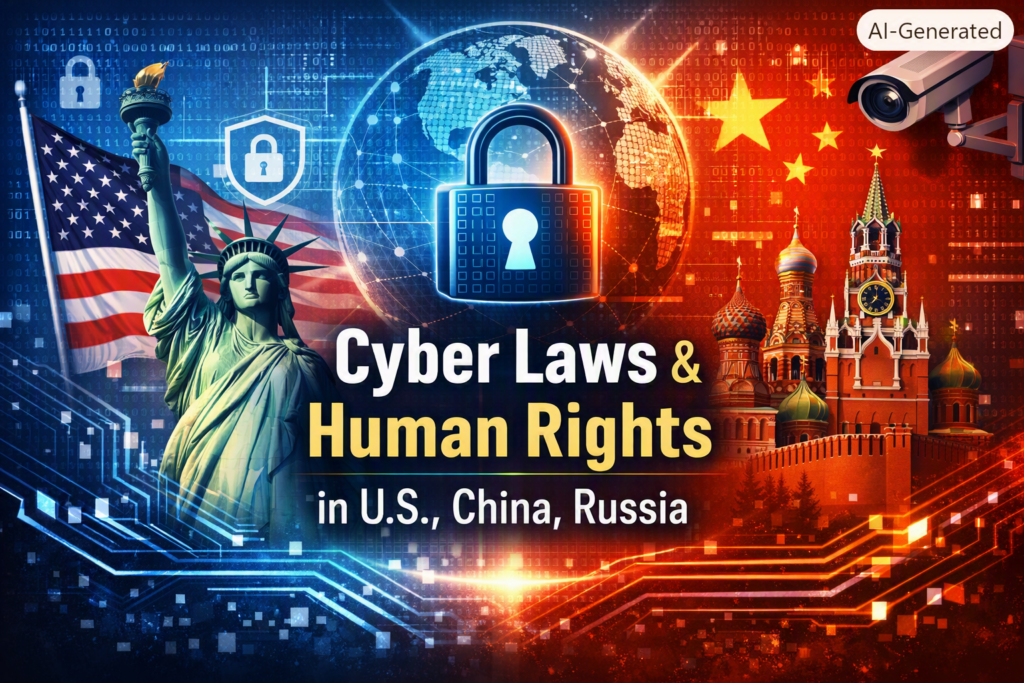
United States
The U.S. has seven major federal cyber laws along with state‑level regulations. These laws protect citizens’ digital rights and regulate industries such as healthcare, finance, defense, and payment systems.
Key federal laws include:
- Computer Fraud and Abuse Act (CFAA) – covers hacking, unauthorized access, malware, and viruses.
- Electronic Communications Privacy Act (ECPA) – protects electronic communications and penalizes wiretapping.
- Economic Espionage Act & Defend Trade Secrets Act – safeguard trade secrets.
- HIPAA (1996) – protects health insurance coverage, patient data, and prevents healthcare fraud.
- COPPA – protects children under 13, requiring parental consent for online data collection.
- Gramm‑Leach‑Bliley Act (GLBA) – secures financial institution data.
- Fourth Amendment – protects against unwarranted search and seizure of digital devices.
Overall, U.S. cyber laws are citizen‑focused, aiming to balance security with individual rights.
China
China updated its Cybersecurity Law in 2026, covering 10 sectors including national security, personal data, and critical infrastructure.
Key points:
- Three main laws and two regulations govern cyberspace.
- Companies must store data on Chinese servers and cooperate with law enforcement.
- Human rights groups criticize the law for limiting freedom of expression and compromising privacy.
- Foreign businesses express concern about strict compliance requirements.
China’s cyber laws prioritize state security over individual rights.
Russia
Russia’s cyber space is governed by three main laws:
- Federal Law No. 149‑FZ (2006) – regulates websites and restricts illegal content.
- Sovereign Internet Law (2019) – allows Russia to operate its own internet and disconnect from the global web.
- Federal Law No. 152‑FZ (2006) – enables monitoring of personal data.
Human rights groups report increased censorship and restrictions on apps like WhatsApp, Facebook, and Telegram.
Russia’s cyber laws emphasize government control and limit citizens’ digital freedoms.
Conclusion
These differences impact foreign investment and global digital cooperation.
U.S. cyber laws: More inclined toward protecting citizens’ rights.
China & Russia: Focused on state security, often at the expense of privacy and freedom.
Cyber Laws & Human Rights in U.S., China, Russia
United States The U.S. has seven major federal cyber laws along with state‑level regulations. These …
What is Network Security and Why is it Important?
In today’s increasingly connected world, where technology touches every aspect of our lives, the nee…
The Best Password Managers: Which One Should You Use?
Let’s be honest—keeping track of passwords is a nightmare. You’ve got work logins, personal accounts…
What are the different Fields of Cybersecurity?
Cybersecurity has become one of the most critical fields in today’s digital landscape, with cy…
Best VPNs of 2025
The Best VPNs of 2025: Protect Your Privacy with the Right Choice In today’s digital world, online p…
What is a VPN? VPN & it’s Types
What is a VPN? Here’s What You Need to Know Let’s face it: we spend a lot of time online these days.…
